
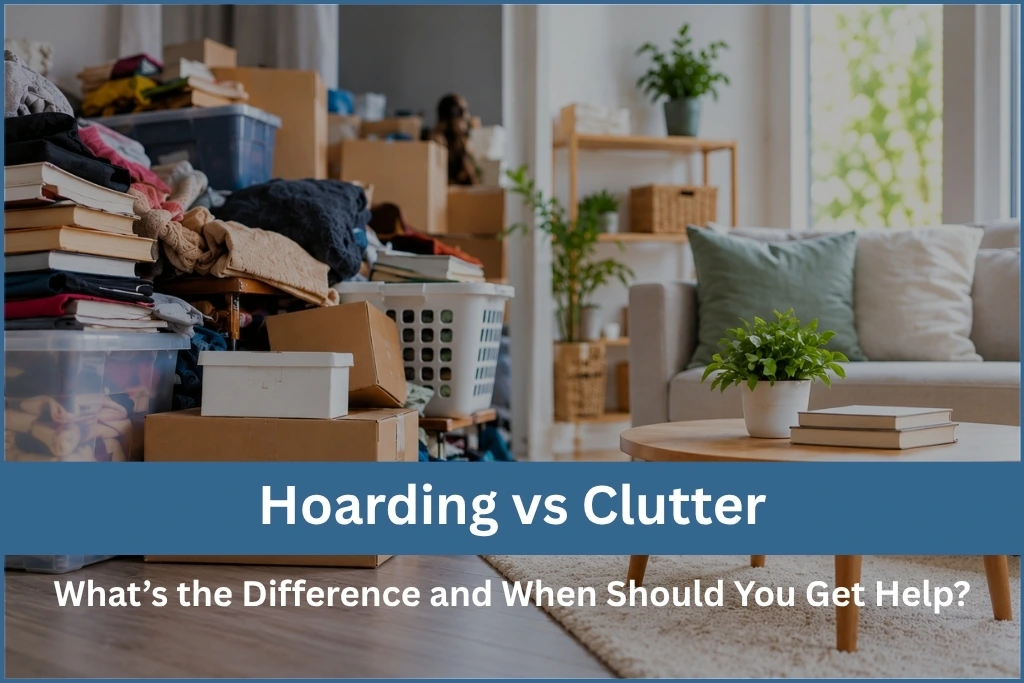
A dining table covered with paperwork. Boxes that have been sitting in the spare room for months. A wardrobe that will barely close. A garage where finding anything has become a challenge.
Clutter can build up in almost any home.
Sometimes it happens during a busy period. Sometimes it follows a move, a change in the family, downsizing or years of putting off sorting. Before long, a small pile can turn into several rooms that feel difficult to manage.
But having a cluttered home does not automatically mean someone is hoarding.
The difference between hoarding and clutter is not simply about how much stuff someone owns or how tidy their home looks. It is also about how difficult it is to make decisions about belongings, how the home can be used and how the situation affects everyday life.
Understanding that difference can help you work out what to do next, whether you are concerned about your own home or trying to support a parent, relative or friend.
What Is the Difference Between Hoarding and Clutter?
Clutter usually means there are more belongings in a space than can be comfortably organised or stored.
You might have clothes you no longer wear, paperwork waiting to be sorted, unused kitchen items, children’s belongings, old furniture or boxes that have never been unpacked.
The job may feel overwhelming, but once you start, you can usually make decisions about what stays and what goes.
You might say:
- “I haven’t used this in years.”
- “I already have three of these.”
- “This doesn’t fit anymore.”
- “I’m happy to donate this.”
Those decisions are not always easy, especially when sentimental belongings are involved, but they can usually be made.
Hoarding can look different.
A person may find it very difficult to let belongings go, including items that other people might see as having little practical use. The thought of discarding something may create strong discomfort or distress.
As more possessions accumulate, they can start affecting how the home is used. A dining table might no longer be available for meals. A spare bedroom may become inaccessible. Boxes may reduce the space available in hallways. Kitchen benches may become difficult to use.
This is why simply looking at the number of belongings does not tell the whole story.
A Cluttered Home Does Not Mean Someone Is a Hoarder
The word “hoarder” is sometimes used casually to describe anyone who keeps a lot of things. That can be unfair and unhelpful.
A person might have a very cluttered home because they have recently moved, inherited belongings from a family member or simply have not had time to sort through years of possessions.
Someone preparing to move into a smaller home may suddenly have decades of belongings to deal with.
The important question is not, “Does this house look messy?”
It is more useful to ask, “Can the person make decisions about their belongings, and is the home still working for them?”
A crowded garage that needs a weekend of sorting is very different from a situation where letting go of individual items feels almost impossible.
Why Does Clutter Build Up?
Clutter often builds gradually. It can start with one cupboard.
When that cupboard becomes full, things move into the spare room. When the spare room fills up, boxes are placed in the garage. Items that need sorting are put aside for “later”. Later never quite arrives.
There are also times in life when belongings accumulate much faster than usual. Moving house is a good example. Downsizing can create another challenge. Bereavement can also leave families responsible for sorting someone else’s belongings at an already difficult time.
There does not have to be one obvious reason. Sometimes the amount of stuff simply grows faster than the household can deal with it.
Signs the Clutter Is Starting to Affect Everyday Life
Rather than worrying about whether your home meets a particular definition, look at how you are able to use it.
Can you cook comfortably in the kitchen? Can you sit at the dining table? Can you easily reach your bed? Can doors and cupboards open properly? Can you move through the main areas of the home without having to step around belongings? Can a tradesperson get to something that needs repairing?
If the answer to several of these questions is no, the problem may need more than a quick tidy-up.
Other signs include repeatedly trying to declutter but getting nowhere, avoiding having visitors because of the condition of the home, or feeling so overwhelmed by the amount of work that you do not start at all.
This does not automatically mean hoarding is involved. It does suggest that some practical support could be useful.
If the amount of belongings has reached the point where normal living areas are difficult to use, hoarding clean-up support in Sydney can provide a more structured way to start working through the home.
Start With the Problem That Is Affecting You Most
A common mistake is deciding to “declutter the whole house”. That sounds like one task. It is actually hundreds of tasks and decisions.
Start smaller.
Instead of “I need to clean out this entire house”, try “I want to be able to eat at the dining table again”, “I want to clear this section of the bedroom”, or “I want to be able to park the car in the garage”.
These are clear goals. They also give you somewhere sensible to begin.
Finishing one useful area can make a bigger difference than spending a day moving belongings between several rooms without completing any of them.
Begin With the Easier Decisions
Do not start with your most sentimental possessions.
Old photographs, family letters, children’s keepsakes and inherited belongings can take a long time to sort because the decision is about much more than the object itself.
Start with things that require less thought. That might include obvious rubbish, broken items you do not intend to repair, duplicate household goods or clothes you already know you will not wear again.
Getting through some easier decisions first helps you build momentum. You can come back to the difficult things later.
Keep Your Sorting System Simple
You do not need ten different piles across the lounge room.
For many homes, four basic groups are enough:
- Keep: Things you use, need or genuinely want in your home.
- Donate: Useful items you no longer need and are comfortable passing on.
- Sell: Items worth selling if you realistically have the time to do it.
- Dispose or recycle: Things that are damaged, unusable or no longer suitable to pass on.
Be particularly careful with the “sell” pile. It is easy to create several boxes of things that you intend to sell online. Six months later, those same boxes may still be sitting in the garage.
If you plan to sell something, give yourself a realistic timeframe to list it.
What About Sentimental Belongings?
This is where decluttering often slows down.
A chipped cup may look worthless to somebody else, but it might remind you of your grandmother. An old school uniform might represent an important part of your child’s life. A piece of furniture may be connected with someone who is no longer here.
There is no need to treat these decisions in the same way as clearing old packaging from a cupboard.
Sometimes it helps to ask what you are trying to preserve. Is it the item itself? The memory connected with it? The person who gave it to you? The family story?
You might decide to keep the item. That is fine. Decluttering is not about removing everything that does not have an obvious practical use.
In other situations, keeping one or two meaningful pieces from a larger collection may feel right.
Helping a Parent or Family Member With Clutter
It can be frustrating to see someone you care about living in a home that is becoming increasingly difficult to manage.
From the outside, you may immediately see things that could go. The person living there may see something completely different.
Walking in with rubbish bags and saying, “We’re getting rid of all this today”, is unlikely to make the conversation easier.
Start with what matters to them. Maybe they would like their grandchildren to stay overnight. Perhaps they want to use the dining table again. Maybe they are preparing to move and know they cannot take everything with them.
A shared goal gives the sorting process a purpose. Instead of arguing about whether a particular item is worth keeping, you can ask whether keeping it helps them reach the goal they have chosen.
If a move is part of the reason for decluttering, our guide on how to talk to your parents about downsizing offers more practical ways to approach the conversation.
What Should You Avoid Doing?
Do not secretly clear someone’s possessions while they are away. Even if the home looks much better afterwards, removing belongings without involving the person can damage trust.
Also be careful about the language you use. Questions such as “Why on earth are you keeping this?” or “How did you let the house get this bad?” can make someone feel that they need to defend themselves rather than make decisions.
Try simpler questions:
- “Would you like to keep this?”
- “Are you comfortable donating this one?”
- “Where would you like this to live?”
The aim is to keep the person involved.
When Clutter Becomes a Safety Issue
Sometimes a clutter problem needs attention because the home is becoming difficult or unsafe to use.
Blocked entrances, narrow walkways or belongings stacked in unstable ways should not be ignored. There can also be situations involving rubbish, pests, sanitation problems, damaged areas of the property or other hazards.
At that point, the priority is not making the home look tidy. It is working out what needs to happen so the property can be used safely.
Some homes may need help from more than one type of professional. Decluttering assistance has a practical role, but it does not replace specialist cleaning, trades, pest services, waste services, healthcare or other professional support where those are required.
When Professional Decluttering Help Can Make a Difference
There is no rule saying you have to sort everything yourself.
Sometimes the biggest benefit of having another person there is simply having structure. Instead of walking into a room and wondering where to begin, you can work through one section at a time.
Professional help may be useful for sorting belongings, grouping similar items together, working through decisions, organising the things you want to keep and planning what will happen to everything that is leaving the home.
It does not mean somebody else decides what you are allowed to own. You remain involved in the decisions.
Some people need help with one difficult room. Others need support across most of the home.
If everyday clutter and home organisation are the main problems, professional decluttering assistance can help make a large job feel more manageable.
What If You Are Also Downsizing?
Decluttering often becomes more urgent when there is a move ahead.
A large family home may comfortably hold furniture and possessions collected over many years. Moving into a smaller apartment, retirement village or another smaller property changes how much space is available.
Try not to think only about what you are leaving behind. Think about the home you are moving into.
Which furniture will actually fit? How much wardrobe space will you have? Will there be a garage? How much kitchen storage is available?
These practical questions can make decisions easier because you are choosing belongings for a real space rather than simply trying to get rid of things.
For people facing this change, downsizing and relocation support can help with the practical work involved in sorting possessions and preparing for the next home.
How Do You Know What Type of Help You Need?
Start with what is actually causing difficulty.
If the home is generally functional but you have several cluttered areas you cannot seem to sort, ordinary decluttering support may be enough.
If you are moving, you may need a combination of decluttering, planning and practical moving support.
If belongings have built up throughout the property and rooms can no longer be comfortably used, you may need more hands-on help with the clearing process.
If there are serious health, safety or mental health concerns, other appropriate professionals may also need to be involved.
You do not need to work out the perfect label before asking for help. Explain what is happening in the home, what is making everyday life difficult and what you would like to change.
One Small Area Is Enough to Start
The difference between hoarding and clutter is not whether a home looks perfectly tidy.
Clutter happens in normal homes for all sorts of reasons. The important questions are how difficult it has become to deal with the belongings and whether they are starting to interfere with everyday life.
If you are feeling overwhelmed, forget about fixing the entire house today.
Choose one area. Make one useful space easier to use. Then decide what comes next.
If you are in Sydney and the job feels too large to manage alone, Declutter Assistance can provide practical, respectful support. The focus is on helping you work through the home step by step, without judgement and without forcing decisions about the things that matter to you.
FAQs:
No. A home can be cluttered without hoarding being involved. Everyday clutter may result from lack of time, limited storage, a move or years of accumulated belongings. Hoarding can involve much greater difficulty letting possessions go and may begin to affect how normal living areas can be used.
Look at how the home functions. If you cannot comfortably use important rooms, access cupboards or appliances, move through parts of the house or arrange necessary repairs, it may be time to get some help.
Do not start with the whole house. Pick one small area that would make everyday life easier. It could be a dining table, one kitchen bench, a chair, one cupboard or a section of the bedroom. Finish that area before choosing the next one.
Start by listening rather than deciding what should be removed. Ask what they would like to improve about their home. A shared goal can make the conversation easier. Avoid throwing belongings away without their involvement.
Professional decluttering can provide practical support with sorting, organising and working through belongings. If there are concerns about hoarding disorder or a person’s mental health, decluttering support should not be considered a replacement for appropriate healthcare.
No. The goal is not to make your home empty or minimalist. It is to decide what you use, need and value, then organise those belongings so your home works better for you.
Yes. One room can be a sensible starting point. It allows you to focus on a manageable area and see progress before deciding whether you need help elsewhere in the home.